
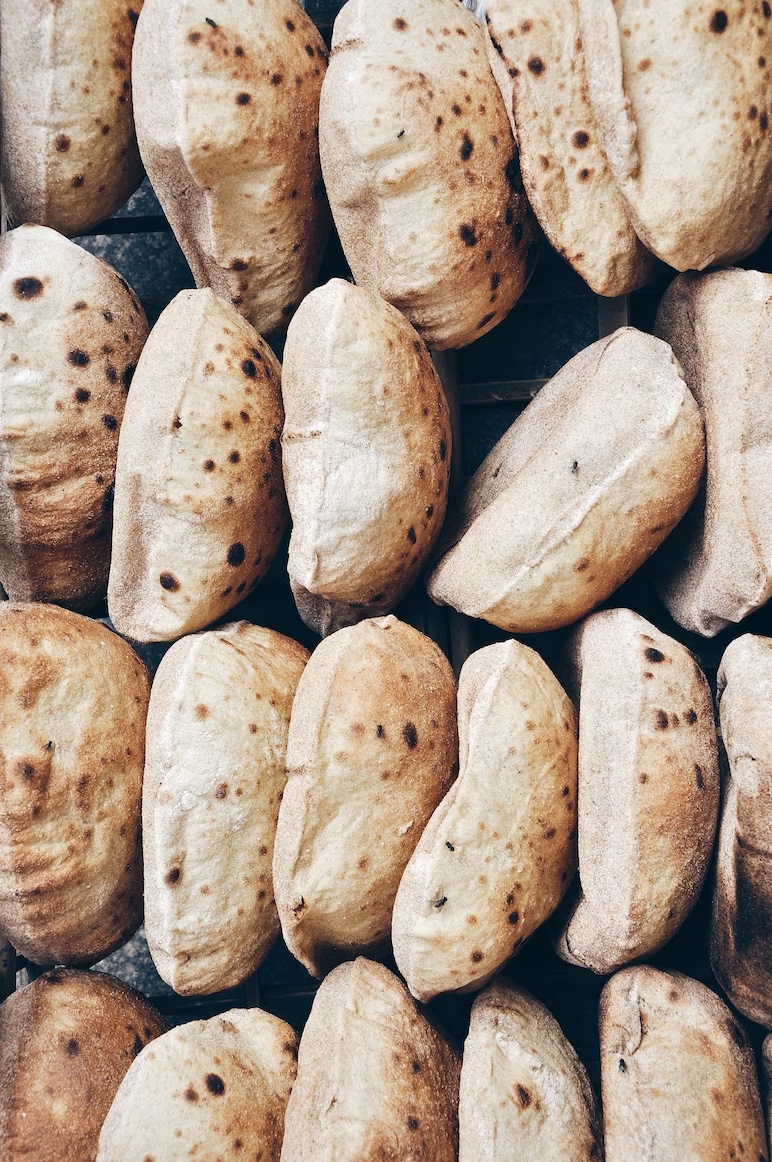
Warm, fragrant home-baked pita is obviously superior, and there’s a bit of a thrill when the breads puff up in the oven.
Pita Bread
And once you get the hang of it, it’s not difficult. Is it worth making pita at home? Absolutely. Store-bought pita (like store-bought sandwich bread) is often several days old. For the best flavor, try to get freshly milled whole- wheat flour. Even though only a little is called for in the recipe, it makes a difference.
Ingredients
- 2 tsp active dry yeast
- ½ tsp sugar
- 35 g whole-wheat flour (preferably freshly milled)
- 310 g unbleached all-purposed flour
- 1 tsp kosher salt
- 2 tbsp olive oil
Directions
- Make sponge: Put 1 cup lukewarm water in a large mixing bowl. Add yeast and sugar. Stir to dissolve. Add the whole-wheat flour and 1/4 cup all-purpose flour and whisk together. Put bowl in a warm (not hot) place, uncovered, until mixture is frothy and bubbling, about 15 minutes.
- Add salt, olive oil and nearly all remaining all-purpose flour (reserve 1/2 cup). With a wooden spoon or a pair of chopsticks, stir until mixture forms a shaggy mass. Dust with a little reserved flour, then knead in bowl for 1 minute, incorporating any stray bits of dry dough.
- Turn dough onto work surface. Knead lightly for 2 minutes, until smooth. Cover and let rest 10 minutes, then knead again for 2 minutes. Try not to add too much reserved flour; the dough should be soft and a bit moist. (At this point, dough may refrigerated in a large zippered plastic bag for several hours or overnight. Bring dough back to room temperature, knead into a ball and proceed with recipe.)
- Clean the mixing bowl and put dough back in it. Cover bowl tightly with plastic wrap, then cover with a towel. Put bowl in a warm (not hot) place. Leave until dough has doubled in size, about 1 hour.
- Heat oven to 475 degrees. On bottom shelf of oven, place a heavy-duty baking sheet, large cast-iron pan or ceramic baking tile. Punch down dough and divide into 8 pieces of equal size. Form each piece into a little ball. Place dough balls on work surface, cover with a damp towel and leave for 10 minutes.
- Remove 1 ball (keeping others covered) and press into a flat disk with rolling pin. Roll to a 6-inch circle, then to an 8-inch diameter, about 1/8 inch thick, dusting with flour if necessary. (The dough will shrink a bit while baking.)
- Carefully lift the dough circle and place quickly on hot baking sheet. After 2 minutes the dough should be nicely puffed. Turn over with tongs or spatula and bake 1 minute more. The pita should be pale, with only a few brown speckles. Transfer warm pita to a napkin-lined basket and cover so bread stays soft. Repeat with the rest of the dough balls.
- Some measurements for dry ingredients are given by weight for greater accuracy. The equivalent measurements by volume are approximate.
- Don’t roll the dough too thin. Between the 1/8" here and the 1/4" is probably going to be better for pocketing.
- The pan you cook these on has to be very hot when you place the dough or it won’t puff properly. Give the pan about a minute in the oven by itself to re-heat between pitas.
- If you want perfect pockets you should fill a spray bottle with water to mist them. When you toss one into the oven, just spray it once or twice. This will ensure even and consistent puffing of the bread.
- Another rising tip: Instead of flipping the dough occasionally while rolling, keep the bottom on the bottom and just rotate the dough. This seemed to help with the rising in the oven.